Tengkoma Peak: Location, Climbing History and Summit Experience
Tengkoma Peak is one of Nepal's lesser-known high-altitude climbing destinations, rising to 6,215 meters (20,390 feet) in the Kanchenjunga region of Taplejung District of eastern Nepal. Situated in the remote Janak Himal range, close to Kanchenjunga North Base Camp (Pangpema), Tengkoma Peak offers an extraordinary combination of wilderness trekking, high-altitude climbing, Himalayan culture and panoramic mountain scenery.
Unlike the more crowded climbing destinations of the Everest region, Tengkoma Peak takes climbers deep into one of Nepal's most remote mountain landscapes. The approach passes through traditional Himalayan settlements, rhododendron and alpine forests, rugged valleys, glaciers and moraines before reaching the high-altitude climbing area. The journey itself is therefore an important part of the Tengkoma Peak experience.
For well-prepared adventurers, climbing Tengkoma Peak is more than reaching a 6,215-meter summit. It is an opportunity to explore the remote Kanchenjunga wilderness, stand beneath some of the world's most impressive mountains and experience a quieter side of Nepal's Himalaya.
Where Is Tengkoma Peak Located?
Tengkoma Peak is located in eastern Nepal's Kanchenjunga region, within the Janak Himal range of Taplejung District. The mountain lies close to the route leading toward Kanchenjunga North Base Camp, also known as Pangpema, at approximately 5,143 meters.
The peak is situated within the broader Kanchenjunga Conservation Area, one of Nepal's most spectacular protected Himalayan landscapes. The surrounding region is characterized by dramatic mountain walls, glaciers, alpine valleys, forests and isolated mountain communities.
The remote location is one of the defining characteristics of Tengkoma Peak. Reaching the climbing area requires a long approach through eastern Nepal rather than a short flight directly to a popular trekking hub. The standard South Col Adventures route travels from Kathmandu toward Biratnagar and Taplejung before entering the Kanchenjunga trekking region through Sekathum, Amjilosa, Gyabla, Ghunsa, Kambachen and Lhonak.
The journey gradually changes from lower-elevation forests and villages into an increasingly rugged alpine environment. As climbers approach Lhonak and Pangpema, the landscape becomes dominated by glaciers, moraines, snow-covered peaks and enormous Himalayan valleys.
Tengkoma Peak and Pangpema
One of the most interesting aspects of Tengkoma Peak is its relationship with the route toward Pangpema, the northern base-camp area of Kanchenjunga.
Mountain documentation places Tengkoma on the northern route, approximately halfway between Lhonak and Pangpema, and records extensive panoramic views from its southern ridge.
This makes the Tengkoma expedition more than a straightforward summit climb. The approach itself is an important part of the experience, allowing climbers to explore one of the most spectacular high-altitude environments in Nepal.
The Journey Toward Pangpema
The approach gradually becomes more dramatic as the trail moves beyond the lower valleys. Ghunsa, Kambachen and Lhonak provide important stages on the journey toward the northern Kanchenjunga landscape.
Beyond Lhonak, vegetation becomes increasingly sparse and the landscape is dominated by glaciers, moraines, snow-covered peaks and enormous mountain walls.
For many climbers, reaching the Pangpema area is one of the highlights of the entire Tengkoma Peak climbing experience.
Tengkoma Peak and Kanchenjunga
One of the greatest attractions of Tengkoma Peak is its proximity to the Kanchenjunga massif.
At 8,586 meters, Mount Kanchenjunga is the world's third-highest mountain, and its enormous presence dominates the landscape around the northern Kanchenjunga region. The Nepal Tourism Board identifies Kanchenjunga as the world's third-highest mountain and highlights the area's long mountaineering history.
From the Tengkoma climbing area and surrounding high-altitude trails, climbers can experience magnificent views of Kanchenjunga, Jannu/Kumbhakarna, Yalung Kang, Kabru, Rathong and other Himalayan peaks.
This extraordinary mountain setting is one of the main reasons Tengkoma Peak stands apart from more commercialized climbing destinations in Nepal.
How High Is Tengkoma Peak?
Tengkoma Peak stands at 6,215 meters (20,390 feet) above sea level.
At this elevation, altitude becomes one of the major challenges of the climb. Even though Tengkoma Peak is generally described as relatively non-technical under normal conditions, the combination of high altitude, cold temperatures, rugged terrain, snow and changing weather makes it a serious Himalayan climbing objective.
The expedition therefore requires more than basic physical fitness. Good endurance, previous high-altitude trekking experience, proper acclimatization and familiarity with mountain equipment are strongly recommended.
Tengkoma Peak Climbing History
The climbing history of Tengkoma Peak is part of what makes the mountain particularly interesting.
Unlike famous Himalayan peaks whose climbing histories are extensively documented, Tengkoma has a comparatively obscure mountaineering history. Available historical sources do not completely agree on the date of the mountain's earliest ascent.
One mountaineering source records that Tengkoma Peak was first climbed in 1933 and subsequently became largely forgotten until the mountain was reopened to climbers in 1998. The same source notes that its 1999 expedition was only the third team to have officially ascended the peak.
However, a 1998 Medical Expeditions report identifies Tengkongma at approximately 6,210 meters and states that its first recorded ascent took place during a Swiss expedition in 1949.
These differing historical records illustrate how poorly documented some of the lesser-known Himalayan peaks have been, particularly compared with major mountains such as Everest and Kanchenjunga.
Tengkoma Peak Reopens to Climbers
The modern history of Tengkoma Peak became more significant in the late 1990s as climbing opportunities expanded in the Kanchenjunga region.
Historical expedition records state that Tengkoma was reopened to climbers in 1998 after decades of limited activity.
The late-1990s period brought renewed exploration to the region. Expedition records from 1999 document a successful Tengkoma climbing attempt in which all eight members of one expedition reached the summit, despite difficult snow conditions elsewhere in the surrounding mountains.
This renewed interest helped establish Tengkoma as an attractive objective for climbers looking for a remote 6,000-meter Himalayan experience away from Nepal's more crowded climbing routes.
What Makes Tengkoma Peak Special?
The appeal of Tengkoma Peak is not based simply on its altitude. Its real attraction comes from the combination of remote location, spectacular scenery, high-altitude trekking and an achievable but serious summit objective.
1. Remote Himalayan Wilderness
Tengkoma is located far from the busy trekking corridors of the Everest region. The approach takes climbers through the isolated Kanchenjunga landscape, where long stretches of trail remain surrounded by forests, glaciers and mountains.
2. Close to Kanchenjunga North Base Camp
The expedition incorporates the remarkable journey toward Pangpema, the viewpoint and base-camp area on the northern side of Kanchenjunga. This gives climbers an opportunity to experience one of Nepal's most spectacular high-altitude trekking environments before beginning the summit phase.
3. A 6,215-Meter Summit
Reaching 6,215 meters provides a genuine Himalayan mountaineering achievement. The elevation is high enough to demand serious acclimatization while remaining considerably below Nepal's eight-thousand-meter expedition objectives.
4. Relatively Non-Technical Character
Under favorable mountain conditions, Tengkoma Peak is generally regarded as a relatively non-technical climbing objective. However, this should not be confused with an easy climb. Snow, ice, weather and route conditions can significantly change the difficulty of the mountain.
5. Spectacular Kanchenjunga Views
The mountain's position near the Kanchenjunga massif provides one of the most impressive visual settings available on a 6,000-meter peak in Nepal.
The Tengkoma Peak Climbing Experience
The Tengkoma Peak climbing experience begins long before summit day.
The approach itself is an adventure through changing Himalayan landscapes. Starting from the lower valleys, the trail gradually enters rhododendron, oak and bamboo forests before reaching higher settlements and alpine terrain.
The route passes through important mountain settlements including Ghunsa, Kambachen and Lhonak. These villages provide a fascinating glimpse into life in one of Nepal's most remote mountain regions.
As the altitude increases, the vegetation becomes increasingly sparse. Forest trails give way to rocky valleys, glaciers, moraines and vast mountain landscapes.
The excursion toward Pangpema provides another major highlight. Standing beneath the enormous Kanchenjunga massif gives climbers valuable exposure to high altitude while also creating one of the most memorable moments of the entire expedition.
After the approach and acclimatization phase, the expedition moves toward Tengkoma Base Camp, where the climbing phase begins.
Tengkoma Peak Base Camp
Reaching Tengkoma Base Camp marks an important transition from trekking to climbing.
The landscape becomes more rugged and alpine, and the focus shifts toward preparing for the summit attempt. Climbers organize their equipment, review climbing techniques and receive guidance from the climbing team.
Because the mountain is remote, preparation at Base Camp is particularly important. Climbers need to be ready for cold temperatures, thin air, changing weather and demanding terrain.
The South Col Adventures itinerary includes tented camping at the Tengkoma Base Camp and preparation for the summit attempt before descending toward the Lhonak area after the climb.
Tengkoma Peak Summit Day
The Tengkoma Peak summit day is the defining moment of the expedition.
Climbers normally begin very early, often before sunrise, when conditions are generally more favorable and there is more time available for the ascent and descent.
From Base Camp, the route gradually enters higher and colder terrain. The thin air becomes increasingly noticeable as the elevation rises, while snow, ice, rock and steep sections require careful movement.
The pace on summit day is deliberately controlled. At 6,215 meters, conserving energy is essential. Climbers follow the instructions of their climbing leaders, use appropriate equipment and maintain a steady rhythm rather than attempting to rush toward the summit.
The final approach can be physically demanding. Every step requires greater effort because of reduced oxygen and the cold, while weather conditions can change rapidly in the high Himalaya.
Reaching the Tengkoma Peak Summit
Standing on the summit of Tengkoma Peak at 6,215 meters is the reward for the long approach, acclimatization and climbing effort.
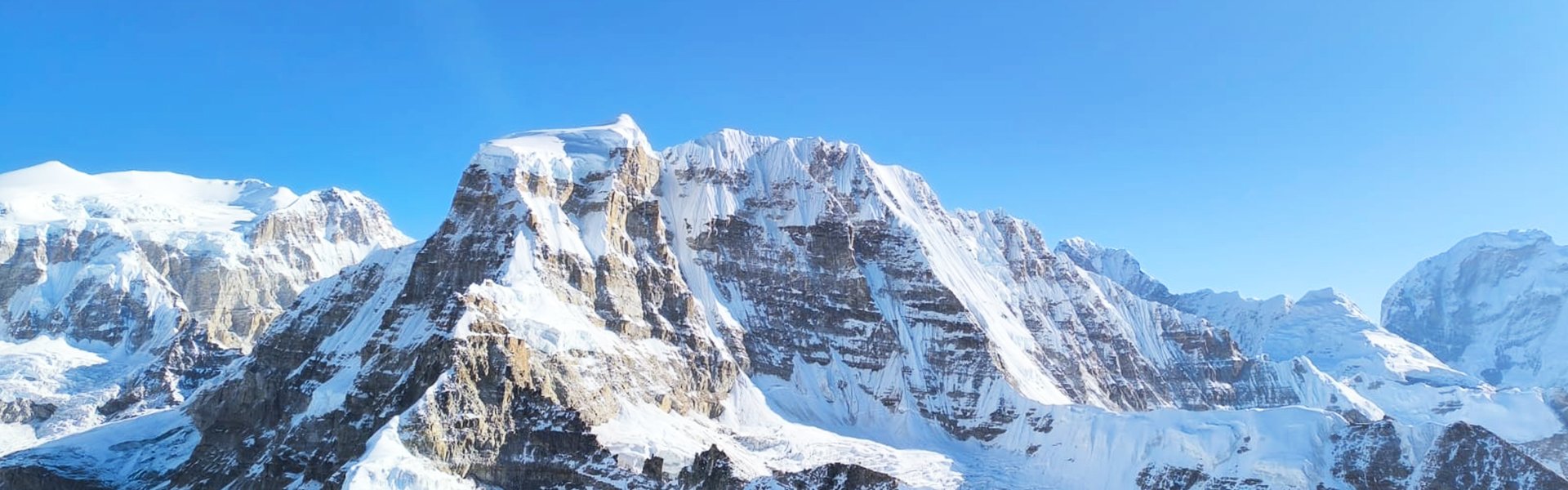
From the summit, the surrounding Himalayan landscape opens dramatically. The enormous Kanchenjunga massif, together with Jannu/Kumbhakarna, Yalung Kang, Kabru, Rathong and neighboring peaks, creates an extraordinary panorama.
For many climbers, the summit moment is not simply about taking photographs or recording an altitude. It is the culmination of days of walking through remote valleys, adapting to high altitude, enduring cold and uncertainty, and finally reaching a summit few travelers ever experience.
After spending an appropriate amount of time at the summit, the team begins the descent. Descending safely is just as important as reaching the top because fatigue, changing weather and altitude remain significant concerns.
Tengkoma Peak Summit Panorama
One of the greatest rewards of climbing Tengkoma Peak is the panoramic mountain scenery from its upper slopes and summit ridge.
Detailed mountain documentation records panoramic views from approximately 5,800 meters on Tengkoma's south ridge, including views toward the surrounding mountains and, toward the southeast, Kanchenjunga (8,586 m) and Yalung Kang (8,505 m).
What Can You See From Tengkoma Peak?
Depending on weather and visibility, the Tengkoma climbing area provides views toward some of the major mountains of the Kanchenjunga Himalaya.
These include:
- Mount Kanchenjunga – 8,586 m
- Yalung Kang – 8,505 m
- Jannu/Kumbhakarna – 7,711 m
- Kabru and surrounding peaks
- High-altitude glaciers
- Lhonak and Pangpema valleys
- Other peaks of the Kanchenjunga Himalaya
Kanchenjunga dominates the wider landscape. Nepal Tourism Board confirms its height of 8,586 meters and identifies it as the world's third-highest mountain
Is Tengkoma Peak Difficult to Climb?
Tengkoma Peak is a moderate-to-challenging high-altitude climbing adventure rather than an easy trekking trip.
The mountain is relatively non-technical under normal conditions, but its 6,215-meter elevation, remote location, long approach, rugged terrain, cold temperatures and demanding summit day make it a serious undertaking.
The biggest challenges include:
- High-altitude exposure
- Long trekking days
- Steep and uneven terrain
- Glacial moraines
- Snow and icy sections
- Cold temperatures
- Changing Himalayan weather
- Limited facilities in remote areas
- A physically demanding summit day
For this reason, previous high-altitude trekking experience is strongly recommended. A climber does not necessarily need extensive technical mountaineering experience, but should have good endurance, mental preparation and the ability to function comfortably in a remote alpine environment.
Who Should Climb Tengkoma Peak?
Tengkoma Peak is particularly suitable for:
- Experienced high-altitude trekkers
- Physically fit adventure travelers
- Aspiring mountaineers seeking a 6,000-meter summit
- Climbers looking for a less-crowded Himalayan objective
- Adventurers interested in the Kanchenjunga region
- Well-prepared first-time peak climbers with previous high-altitude trekking experience
The mountain should not be considered an easy beginner's climb simply because it is relatively non-technical. Altitude and remoteness are major parts of the challenge.
Why Choose Tengkoma Peak Instead of a Popular Trekking Peak?
For travelers comparing Tengkoma Peak with Mera Peak, Island Peak or Lobuche East, the most important difference is the overall experience.
Mera, Island and Lobuche are established and popular climbing destinations in the Everest-region trekking network. Tengkoma, by contrast, takes climbers into the much quieter Kanchenjunga wilderness.
Choosing Tengkoma means choosing:
More wilderness. More solitude. More remote trekking. More exploration.
The mountain combines a 6,215-meter summit with the exceptional landscapes surrounding Kanchenjunga North Base Camp. It is therefore particularly attractive to experienced trekkers who want their peak-climbing journey to feel like a genuine Himalayan expedition rather than simply an extension of a busy trekking route.
Tengkoma Peak: More Than a Summit
The greatest strength of Tengkoma Peak is that the summit is only one part of the adventure.
The journey begins in eastern Nepal and gradually enters the remote Kanchenjunga landscape. Climbers walk through forests and mountain villages, cross rugged valleys, approach glaciers and moraines, experience the extraordinary landscape around Pangpema and eventually establish a high-altitude climbing camp beneath the peak.
Then comes summit day.
At 6,215 meters, the final ascent tests endurance, concentration and acclimatization. When the summit is finally reached, the reward is a spectacular Himalayan panorama and the knowledge that the climber has completed an adventure into one of Nepal's least-crowded mountain regions.
For travelers searching for a remote Himalayan peak, a 6,000-meter climbing experience and spectacular Kanchenjunga scenery, Tengkoma Peak offers an exceptional combination of adventure and exploration.
Climb Tengkoma Peak with South Col Adventures
South Col Adventures organizes Tengkoma Peak Climbing as a 23-day Himalayan adventure combining the Kanchenjunga approach, acclimatization, Pangpema, Tengkoma Base Camp and the summit attempt. The current itinerary reaches 6,215 meters and is designed around gradual altitude gain, climbing support and organized expedition logistics.
For a remote mountain such as Tengkoma, good logistics and experienced mountain staff are especially important. South Col Adventures provides support with permits, transportation, trekking and climbing guides, porter support, accommodation, meals, Base Camp arrangements and summit planning.
The goal is not simply to reach the summit but to make the entire journey—from the first trail in eastern Nepal to the final descent from Tengkoma Peak—safe, organized and memorable.
Final Thoughts
Tengkoma Peak is one of Nepal's most intriguing lesser-known 6,000-meter climbing destinations. Its remote position near Kanchenjunga North Base Camp, fascinating climbing history, relatively non-technical character and spectacular Himalayan scenery make it particularly appealing to experienced trekkers and aspiring mountaineers.
For those willing to travel beyond Nepal's better-known trekking routes, climbing Tengkoma Peak offers something increasingly rare: solitude, exploration and a genuine sense of Himalayan adventure.